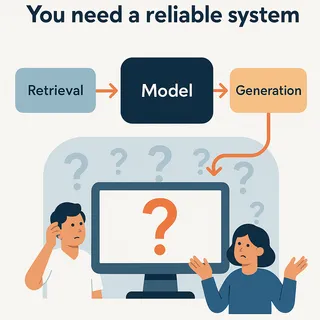
Enterprise AI doesn’t collapse because models are weak—it collapses because teams never measure how retrieval, generation, and cost behave once the system meets reality.
The Smarter Model Fallacy
When an AI system underperforms, the instinct is to reach for a bigger, newer model. GPT-4 didn’t work? Try GPT-4 Turbo. Still not good enough? Wait for GPT-5. This upgrade treadmill feels productive but rarely solves the actual problem.
The real issues hide in plain sight: retrieval pulling irrelevant context, prompts that drift across use cases, or latency that kills user adoption. A smarter model won’t fix a broken pipeline.
What Actually Breaks
Enterprise AI systems fail in predictable ways:
- Retrieval quality degrades - Your vector search returns documents that seem relevant but miss critical context
- Generation drifts - Outputs that worked in testing behave differently with real user queries
- Costs compound silently - Token usage grows without visibility until the monthly bill arrives
- Latency kills adoption - Users abandon systems that take too long to respond
Each of these failures has measurable symptoms. The question is whether anyone is watching the gauges.
Building a Measurable System
A production AI system needs instrumentation at every layer:
Retrieval Metrics
- Precision and recall of document retrieval
- Relevance scores for top-k results
- Query-to-context alignment rates
Generation Metrics
- Output quality scores (automated and human-in-the-loop)
- Hallucination detection rates
- Response coherence measures
Operational Metrics
- Latency percentiles (p50, p95, p99)
- Token consumption by query type
- Error rates and failure modes
The Evaluation Loop
Measurement without action is just expensive monitoring. Build feedback loops that turn metrics into improvements:
- Detect - Automated alerts when metrics drift outside acceptable bounds
- Diagnose - Trace failures back to specific pipeline components
- Iterate - A/B test changes against baseline performance
- Deploy - Roll out improvements with gradual traffic shifting
Starting Small
You don’t need a full observability platform on day one. Start with:
- Log every LLM call with inputs, outputs, and latency
- Sample user feedback on response quality
- Track weekly cost trends
These basics reveal patterns that guide deeper instrumentation.
The Bottom Line
Smarter models will keep arriving. But the teams that win are building systems that measure what matters, iterate based on evidence, and improve reliably over time. The model is just one component. The system is what delivers value.